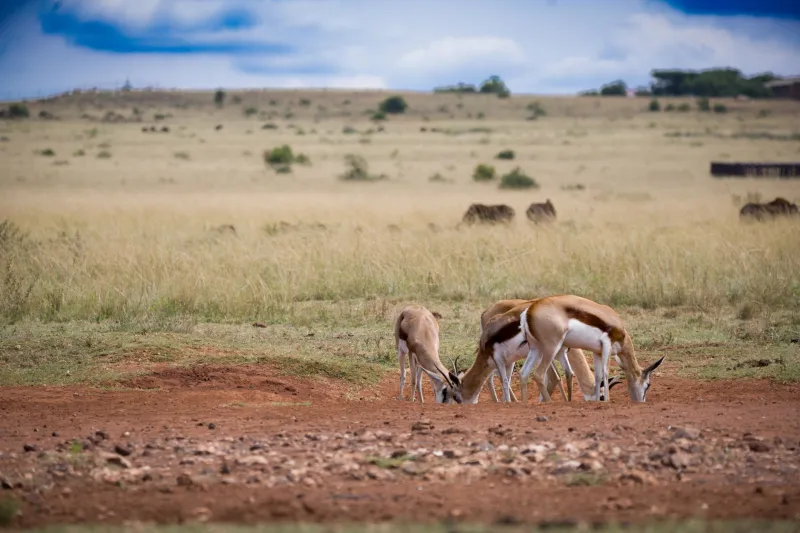
The Lens Is Not a Permit: Photographing Kenya's Wildlife at the Distance the Animal Chooses

Photo by Photo by Carlos Torres on Unsplash on Unsplash
Most visitors to Kenya's parks will, at some point, see a vehicle nose a few meters off the track toward a resting cheetah. The driver is not usually reckless. The passengers are not usually cruel. What produces the maneuver is a set of small, ordinary incentives — a good photograph, a satisfied client, a tip at the end of the day — that converge on a single decision about distance. That decision is the one worth examining, because it recurs hundreds of times a season and because it is, in most cases, entirely avoidable.
Kenya Wildlife Service regulations for national parks are unambiguous on the underlying point: vehicles must remain on designated tracks, and off-road driving is prohibited except where explicitly authorized. Conservancies adjoining the parks often layer their own codes on top, and most specify a minimum approach distance for large mammals, commonly in the range of twenty to thirty meters, though guides consistently note that the animal's behavior — not the tape measure — is the final arbiter.
What the Guides Are Reading
Ask a guide with twenty years in the Mara or Amboseli what they watch for, and the answer rarely concerns meters. It concerns posture.
A relaxed elephant feeds in a slow rhythm, ears loose, tail swinging. An elephant that has stopped feeding, turned square to the vehicle, and spread its ears is not posing. A cheetah that stands up the moment a vehicle settles is not curious; it is calculating an exit. Lions tolerate vehicles at remarkably close range when they are sated and habituated, and tolerate almost nothing when a cub is hidden nearby or a kill is on the ground.
The vocabulary guides use is drawn from behavioral science rather than sentiment: displacement behavior, alert distance, flight initiation distance. The last of these is the one that matters most for photographers. Flight initiation distance is the point at which an animal begins to move away, and once it is crossed, the photograph has already cost something. Repeated crossings carry a measurable price — interrupted feeding, abandoned hunts, displacement from preferred habitat, and in the case of cheetahs in particular, lost hunting opportunities that are not easily recovered.
Why Megapixels Changed the Etiquette
There is a technical reason that proximity pressure has intensified, and it is not simply the rise of social media. Modern camera bodies and long telephoto lenses, including the 100–400mm and 150–600mm zooms that many American travelers rent specifically for a Kenyan safari, make a distant subject fill the frame. A cheetah at sixty meters, photographed at 600mm on a high-resolution sensor, produces an image indistinguishable, on a phone screen, from one taken at twenty meters.
In other words, the closest photographs are no longer the best photographs. The constraint that once justified crowding a sighting has largely dissolved, and the custom has not caught up. Guides interviewed for this article were near-unanimous on the point: the visitors who push hardest for proximity are frequently the ones carrying the least glass, or shooting on a phone whose limits they mistake for the animal's obligation.
The Incentive Problem, Stated Plainly
It would be unfair to place the entire burden on drivers. In Kenya's guiding economy, tipping is a meaningful share of income, and the pressure to deliver a memorable sighting is real. Where a client says "get me closer" and a competitor's vehicle is already off the track, the guide faces a choice between professional judgment and customer satisfaction.
That makes the traveler's own conduct consequential. A passenger who says nothing while a vehicle leaves the track has endorsed the maneuver. A passenger who asks to stop, or who observes that the animal is agitated, changes the arithmetic. Several conservancy managers describe a practical and reliable intervention: telling the guide at the start of the day that you would rather miss a shot than cause a disturbance. Said once, early, it removes the ambiguity for the rest of the trip.
A Checklist for the Vehicle
- Set the expectation before departure. Tell your guide or camp manager you prefer to stay on tracks and will not ask for off-road positioning. Reputable operators welcome this.
- Ask about the minimum distance policy for the conservancy or park you are visiting, and hold to it even when the sighting is exceptional.
- Watch the animal, not the viewfinder. If ears flatten, tail flicks repeatedly, the animal stands, or the herd closes ranks, you are past the threshold. Ask the driver to reverse.
- Limit your time at high-value sightings. Predator sightings in particular attract convoys. Fifteen attentive minutes and a clean exit are worth more than forty minutes of jockeying for angle.
- Skip the cub shot entirely if a den or natal area is involved. Guides know where these are. Photographs of them circulate and draw traffic.
- Never ask a guide to bait, call, or flush an animal. These practices are prohibited in Kenya's national parks and are grounds for license action.
- Do not reward proximity with cash. If a tip is offered, tie it to patience and positioning rather than to how close the vehicle came.
The Obligation After the Shutter Closes
Distance ethics extend past the trip. Metadata in a smartphone photograph can carry precise coordinates, and a geotagged image of a rhino, a lion pride, or a nest site is a location disclosure to anyone who cares to read it. Strip location data before posting, and avoid captioning specifics that identify sensitive sites. If an image captures something of scientific value — a distinctive ear notch, a collared animal, an unusual behavior — consider sending it to the research team working in that landscape rather than only to an audience.
American travelers arrive in Kenya already fluent in a version of this argument. Yellowstone's approach rules for bison, the crowds that gather at roadside bear sightings in the Smokies, the recurring debates over drones in national parks — all rehearse the same tension between access and restraint. The difference in Kenya is that the animals are frequently larger, the sightings rarer, and the guiding economy more directly exposed to visitor expectation.
The photograph is worth taking. It is simply worth taking well: from the track, at the distance the animal has set, with a lens that closes the gap so the vehicle does not have to. Guides will tell you that the best sightings of their careers were rarely the closest ones. They were the ones where nothing ran away.