Listening for Health: Five Soundscape Signals from Kenya’s Wild Places
On a still morning in a Kenyan forest, the first sound is often not a lion or an elephant. It is a layered chorus of birds, insects, and frogs, arriving in shifts as light moves through the canopy. For a growing field of conservation scientists, that chorus is data. Bioacoustics—the study of sounds produced by living organisms—and soundscape ecology—the study of all sounds in a landscape—are giving researchers a way to listen for ecosystem health across Kenya’s forests, savannas, wetlands, and rangelands. In 2026, inexpensive recorders and machine-learning classifiers have made it possible to monitor more sites, for longer periods, than a team of field biologists could cover on foot.
The appeal is practical. Many species are heard before they are seen. Sound travels through vegetation and across boundaries. A recorder can run through the night, when many mammals, frogs, and insects are most active. And acoustic data can be archived, compared across seasons, and shared with communities and managers. The same principles apply in a Kenyan conservancy and an American backyard: listen for what is present, what is missing, and what has changed.
1. A Dawn Chorus with Depth
A healthy habitat tends to produce a dawn chorus with structure. Different bird species call at different frequencies, from low dove coos to high sunbird notes, and at slightly different times. That overlap creates acoustic diversity—a rough measure of how many species are active and how complex the habitat is. In Kenya, recordings from Kakamega Forest, the Aberdare Range, and Mau Forest can reveal layers that a quick walk might miss. When the chorus flattens into a few repeated calls, it may signal lost canopy structure, fewer insectivores, or pressure from edge effects.
For U.S. readers, the comparison is close to home. A spring dawn chorus in a native oak woodland or a restored prairie sounds different from one in a mown lawn. The number of layers matters. So does the timing. Citizen-science recordings, such as those made for local bird projects, can help track those shifts.
2. The Insect Hum That Never Quite Stops
The background hum of crickets, cicadas, bees, and flies is easy to ignore, which is why it is useful. In many Kenyan savannas and forest edges, insect sound provides a continuous acoustic baseline. A sudden drop in that baseline can be as telling as a missing bird call. It may reflect pesticide exposure, loss of flowering plants, dry conditions, or habitat conversion. Because insects are sensitive to temperature and moisture, their sound also shifts with climate patterns.
American gardeners can listen for the same signal. A pollinator garden in mid-summer should not be silent. If the hum disappears, the cause may be local—pesticides, heat, or a lack of blooms—rather than global. The point is to notice.
3. Frog Choruses as Water-Quality Monitors
Amphibians are sensitive to changes in water quality and hydrology. Their choruses, especially after rain, can function as a check on seasonal wetlands, streams, and ponds. In Kenya, recordings from seasonal wetlands and riverine corridors can document which frog species are calling, when breeding begins, and whether a wetland is holding water long enough to support reproduction. A missing chorus may point to altered drainage, pollution, or a dry season that arrived too early.
In the United States, spring peepers and other frogs offer a familiar version of the same test. A pond that once rang out in early spring and now stays quiet is worth investigating. The acoustic signal is not proof by itself, but it is a prompt.
4. Large Mammal Calls and the Low-Frequency Layer
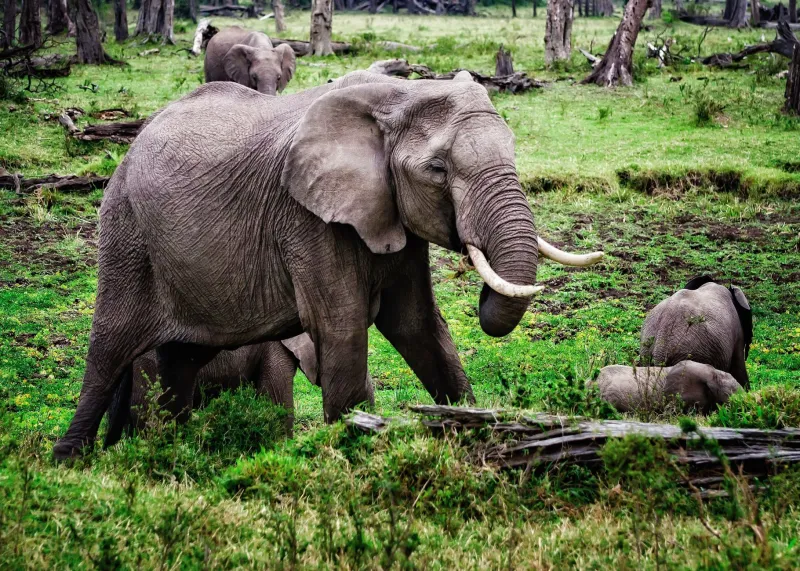
Elephants produce rumbles that extend below the range of human hearing. Lions, hyenas, and other large mammals add calls and footfalls to the soundscape. Acoustic monitors can detect some of these signals, especially with specialized microphones, and can help managers understand when animals are using a corridor or approaching a community. The technology is not a substitute for skilled field observation, and it should not be used to harass wildlife. But it adds a layer that human ears miss.
For travelers, the lesson is humility. A quiet savanna may still be full of low-frequency conversation. The absence of a roar does not mean the absence of lions.
5. The Human Layer of a Working Landscape
A community conservancy is not silent by design. Livestock bells, voices, motorcycles, and schoolchildren are part of the soundscape. In a working rangeland, some human sound can indicate coexistence rather than disturbance. The question is not whether people are present but whether the acoustic pattern is stable and whether wildlife still uses the area. Researchers increasingly analyze the whole soundscape—biological, geophysical, and human—rather than isolating “nature” from “people.”
That has implications for responsible tourism. A quiet group, a guide who speaks softly, and a vehicle that idles less can reduce local acoustic disturbance. So can a ban on playback and drones. Listening becomes a conservation tool when it replaces the urge to provoke a response.
What Silence Can Hide
Silence is not automatically a warning. Midday heat can quiet a savanna. A dry season can reduce frog calls. A migratory bird may be absent because it is wintering elsewhere. This is why acoustic monitoring depends on baselines: repeated recordings across seasons and years, compared with reference sites. A single silent morning proves little. A pattern of missing frequency bands, reduced acoustic diversity, or lost nocturnal insect sound is more meaningful.
How to Listen Without Disturbing
The first rule is to avoid playback. Broadcasting a predator call or a bird song to attract wildlife is a disturbance, not a shortcut. The second is to keep drones grounded in sensitive areas; their whine travels farther than many people realize. The third is to let local guides lead. They often know which sounds are ordinary and which are not.
American readers can join the same practice at home. Record a few minutes of a backyard or local park at dawn, then repeat it in the same spot later in the season. Note the layers: birds, insects, frogs, traffic, voices. Over time, the recording becomes a small archive of change. In Kenya, that same logic is being scaled up across landscapes, one recorder at a time.