The Margin Matters: Reading Wildlife Habitat in Kenya's Cut-Flower Belt
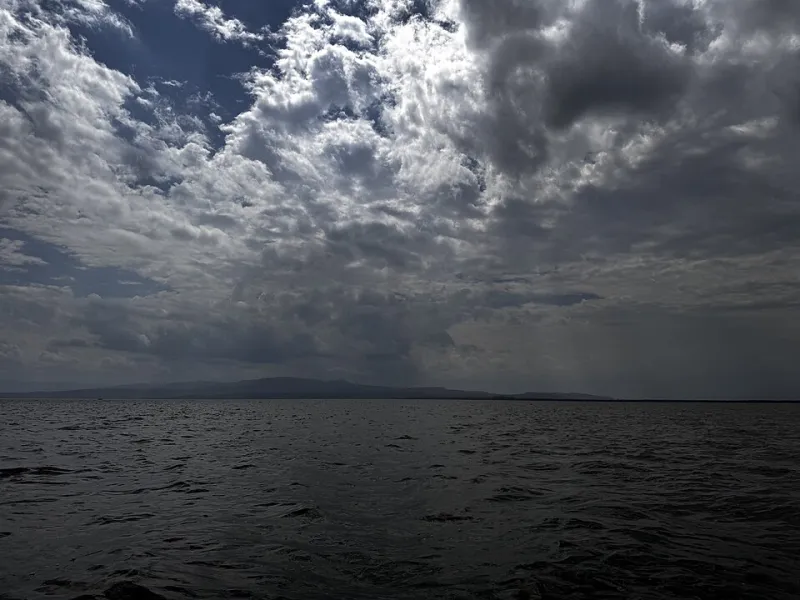
Photo: Letherian3, CC BY-SA 4.0, via Wikimedia Commons
A bouquet of roses on a counter in Ohio or Oregon carries no label describing the field it came from. Yet a substantial share of the cut flowers sold in the United States in winter and early spring originates in a relatively compact belt of greenhouses northwest of Nairobi, clustered around Lake Naivasha in Kenya's Rift Valley. The lake itself is a Ramsar wetland of international importance, designated in 1995, and the basin around it supports African fish eagles, great white pelicans, spotted-necked otters, hippos, and a papyrus fringe that functions as a nursery for fish and amphibians.
Much of the public conversation about this industry concerns carbon footprints, labor standards, and refrigeration. Less discussed — and, in the view of several Kenyan ecologists, more consequential for local biodiversity — is the ecological behavior of the land between the greenhouses: the hedgerows, fallow strips, drainage channels, and riparian buffers that flower farms either preserve or erase.
The Habitat Between the Rows
A flower farm is not a monoculture in the same sense as a grain field. Greenhouses are discrete structures, often separated by service roads, packing sheds, and open ground. Those in-between spaces can hold surprising value. Studies of agricultural margins in East Africa have found that hedgerows and unsprayed verges support insect populations that in turn feed insectivorous birds and bats. Near Naivasha, the acreage that matters most is the land adjacent to the lake and its feeder streams, where remnant vegetation filters runoff and provides cover for small mammals moving between the water and higher ground.
The critical variable is width and continuity. A two-meter strip of grass between two greenhouses is not a corridor; a twenty-meter buffer along a stream, kept free of herbicide and planted with native species, can be. Some farms in the basin maintain such buffers voluntarily or as a condition of certification. Others do not, and there is no single public register that tracks which is which.
This is the central gap. Kenya's flower sector has built reasonably robust systems for auditing pesticide handling and worker safety. It has not built an equivalent system for auditing habitat.
Water Comes Before Blossoms
Roses are thirsty crops, and the Naivasha basin's water balance is contested. Abstraction for irrigation, domestic use, and geothermal activity all draw on the same lake and aquifer system. The basin has been the subject of a water allocation planning process coordinated by Imarisha Naivasha, a multi-stakeholder body, alongside the Water Resources Authority. The Lake Naivasha Basin Sustainability Initiative has likewise worked to bring growers, smallholders, and conservation groups onto a shared set of practices.
For a buyer, the relevant question is not whether a farm has a water policy. It is whether the farm can state its abstraction volume against an independently verified allocation, and whether it has invested in recirculation, drip irrigation, or rainwater capture that reduces net draw. Those investments are measurable. Claims of "water stewardship" without figures are not.
Lake levels fluctuate substantially with rainfall cycles, and attributing any single dry year to a single sector is not scientifically defensible. What is defensible is that the basin's margin for error is narrow, and that horticultural abstraction is part of the equation.
The Pesticide Question a Label Won't Answer
Most Kenyan flower exporters operate under integrated pest management programs, and many have reduced reliance on the most acutely hazardous compounds. But the category matters. Pesticides classified by the World Health Organization as Class Ia or Ib — the most acutely toxic — are subject to restrictions in Kenya and to buyer prohibitions in several European markets. Drift and runoff from greenhouse operations into adjacent wetlands remain a recognized risk, particularly where buffers are thin and application equipment is older.
Post-harvest treatments add another layer. Cut stems are frequently dipped or sprayed with fungicides to prevent botrytis and other molds during shipping, and several of those compounds are under regulatory review in the United States and the European Union. A retailer's residue standard is usually calibrated to food, not to ornamentals, which means flowers occupy a thinner regulatory space than vegetables. That is not an alarm; it is a reason to ask specific questions rather than accept general assurances.
What Certifications Verify — and What They Skip
Schemes such as the Kenya Flower Council's Silver and Gold standards, Fairtrade, Rainforest Alliance, and MPS-ABC each address a different set of criteria. Broadly, they cover record-keeping, worker training, protective equipment, waste handling, and in some cases water and energy use. Habitat conservation appears in some standards as a principle, but rarely as a quantified, field-verified metric with a public score.
A farm can therefore be fully certified and still have converted a riparian buffer to a packing shed three years ago, provided the conversion was permitted. Certification is a floor, not a ceiling.
Five Questions a Florist Can Actually Ask
American florists and grocery buyers have more leverage than they typically use, because the US market is a growth target for Kenyan exporters. A supplier conversation can begin with five concrete questions:
- Which farm or farms supplied this shipment, and in which basin? Farm-level traceability is the precondition for every other question.
- What is the width and condition of the vegetated buffer between the production area and any watercourse or lake shore? Ask for meters, not adjectives.
- Which WHO hazard class of insecticides was applied in the past twelve months, and is there a written IPM plan with a named agronomist?
- What is the farm's verified abstraction volume, and against which allocation? Recirculation and rainwater capture figures should be available on request.
- Has an independent third party assessed habitat on the property in the past three years, and will you share the summary? A certification certificate is not the same document.
A supplier who cannot answer should not be treated as culpable. Many can, and the exercise of asking gradually shifts what gets measured.
The Consumer's Leverage
The American shopper standing in a supermarket aisle is several steps removed from a Naivasha drainage line. But buying decisions aggregate, and retailers respond to questions they receive repeatedly. The most useful consumer move is not a boycott or a slogan. It is a short, specific query directed at the retailer: which farm grew these stems, and what is the farm doing about the vegetated margin between its greenhouses and the lake?
That question is answerable. When enough buyers ask it, it becomes a line item on a supplier scorecard — and then, eventually, a number in a habitat audit that did not previously exist.