The Metadata in Your Memory Card: What Kenyan Ecologists Can Actually Do With a Visitor's Wildlife Photo
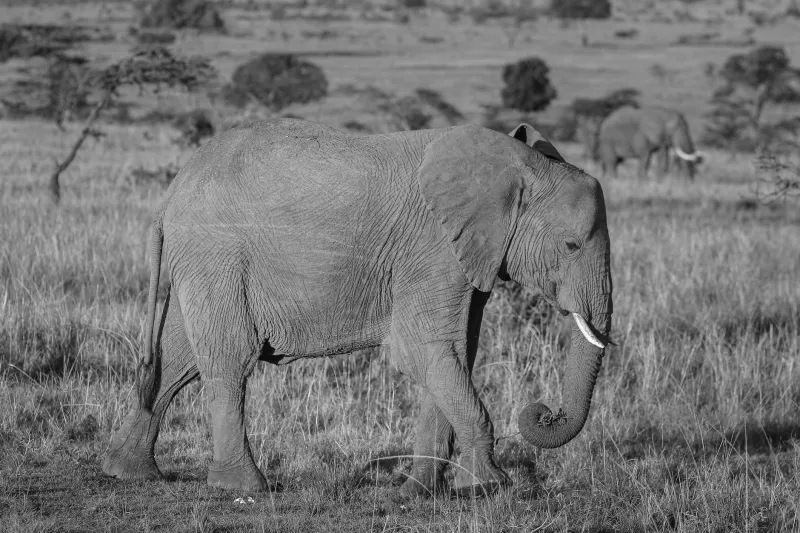
A traveler in a conservancy north of Mount Kenya photographs an elephant crossing a dry riverbed at first light. The image is on social media by lunch. What the traveler may not consider is that the file also carries a timestamp, a coordinate pair, a camera model, and a focal length — a compact set of structured facts that, handled with discipline, can outlast the post itself.
Kenyan ecologists have spent more than a decade assembling camera-trap grids across parks, conservancies, and private ranchlands. Those grids are costly: batteries, memory cards, staff hours, and the unglamorous labor of sorting through hundreds of thousands of blank frames. Visitor photographs are not a substitute for any of that infrastructure. They are, however, a supplementary record — and it is worth stating plainly, in 2026, what that record can and cannot support.
What the file already knows
Three fields do most of the analytical work.
The timestamp establishes when an animal was where. Because camera traps run continuously, time is what allows analysts to separate nocturnal from crepuscular activity, or to test whether a species is shifting its hours in response to heat, livestock, or human traffic. A visitor photograph with an accurate time is a single data point in that larger series.
The coordinate pair places the sighting, with caveats. A phone fix under dense canopy may drift by twenty or thirty meters. A dedicated camera without GPS inherits no position at all, and coordinates added later from a lodge's wireless network can place a lion in a parking lot. Researchers generally treat visitor coordinates as approximate unless a track log or a guide's field note confirms them.
The clock setting is the quietest point of failure. A camera left on the wrong time zone produces records shifted by hours — enough to move a nocturnal species into full daylight and contaminate an activity analysis. Setting the camera to local time on arrival is a ten-second task with outsized consequences.
Three uses researchers can defend
Filling gaps in occurrence maps. Formal occupancy modeling requires repeated surveys at known sites, and incidental sightings do not satisfy that design. They do something else useful: they flag presence in places no grid covers. A confirmed photograph from an unmonitored stretch of river or a community ranch can redirect where the next round of traps is deployed.
Corroborating a rare detection. When a camera-trap image is ambiguous — a partial flank, a blurred hindquarter, a carnivore at the edge of infrared range — an independent photograph taken the same week in the same area can help confirm or overturn the identification. For species that appear rarely in trap data, that corroboration matters disproportionately.
Adding a human-behavior layer. Images submitted directly to a conservancy can carry information about roads, livestock, vehicles, and occasionally wire. A time-stamped photograph of a snare, a carcass, or an unfamiliar camp is the kind of incidental intelligence that patrol planners can act on, provided it reaches them quickly and through a verified channel rather than a public feed.
What the file cannot tell you
No detection is not absence. A visitor who drives a loop and photographs nothing has not demonstrated that nothing is there. Absence claims require effort data that tourism almost never generates.
Effort bias is severe. Tourists photograph what roads reach and what guides know. A map assembled from visitor images will trace the road network as faithfully as it traces wildlife.
Identification errs in predictable ways. Small antelope photographed at distance, juvenile predators, hybrid canids, and partially obscured cats generate a steady share of misidentifications. A review layer — a curator, a species specialist, or a platform with regional moderators — is not bureaucratic decoration; it is the difference between a dataset and a pile of guesses.
Duplication inflates everything. One leopard photographed by forty guests on the same morning becomes forty records unless the images are deduplicated. Where individual identification is possible, coat patterns and whisker spots help. Where it is not, submission timestamps and site metadata allow analysts to cluster likely duplicates and discount them.
Edited files lose their evidence. Exporting, cropping, and screen-capturing strip metadata. A JPEG pulled off a messaging app often arrives with no position and no reliable time.
The ethics are part of the data
A photograph obtained by baiting is not a neutral record. Neither is one taken after a vehicle has left the track to close a distance of fifteen meters. Kenya Wildlife Service regulations prohibit off-road driving in national parks and prohibit feeding wildlife; the same norms hold in most conservancies, whether or not they are posted at the gate. Provenance includes method. A record that documents harassment documents a problem, not a sighting, and researchers who accept such material without context are building a map of their own blind spots.
A visitor's protocol
- Turn on location services and set the camera's clock to local time on the first morning.
- Take a wide frame before the close-up. Context — habitat, road, herd size — is often more analytically useful than a portrait.
- Share the original file, uncropped, wherever possible.
- Record distance, behavior, group size, and whether any vehicle left the track.
- Submit through a platform with regional review, or directly to the conservancy or research station.
- Hold back real-time coordinates for rhino, pangolin, and any species under active poaching pressure. Post after you leave, and strip location from the caption.
The record, not the image
A memory card is a field notebook, but only if it is treated as one. The value of a visitor photograph to Kenyan conservation lies less in its composition than in the discipline surrounding it: an honest time, an approximate place, an unmodified file, and a truthful account of how the animal was approached. Under those conditions, a picture taken on holiday becomes something an ecologist can cite. Without them, it remains what it mostly is — a beautiful image with no argument attached.